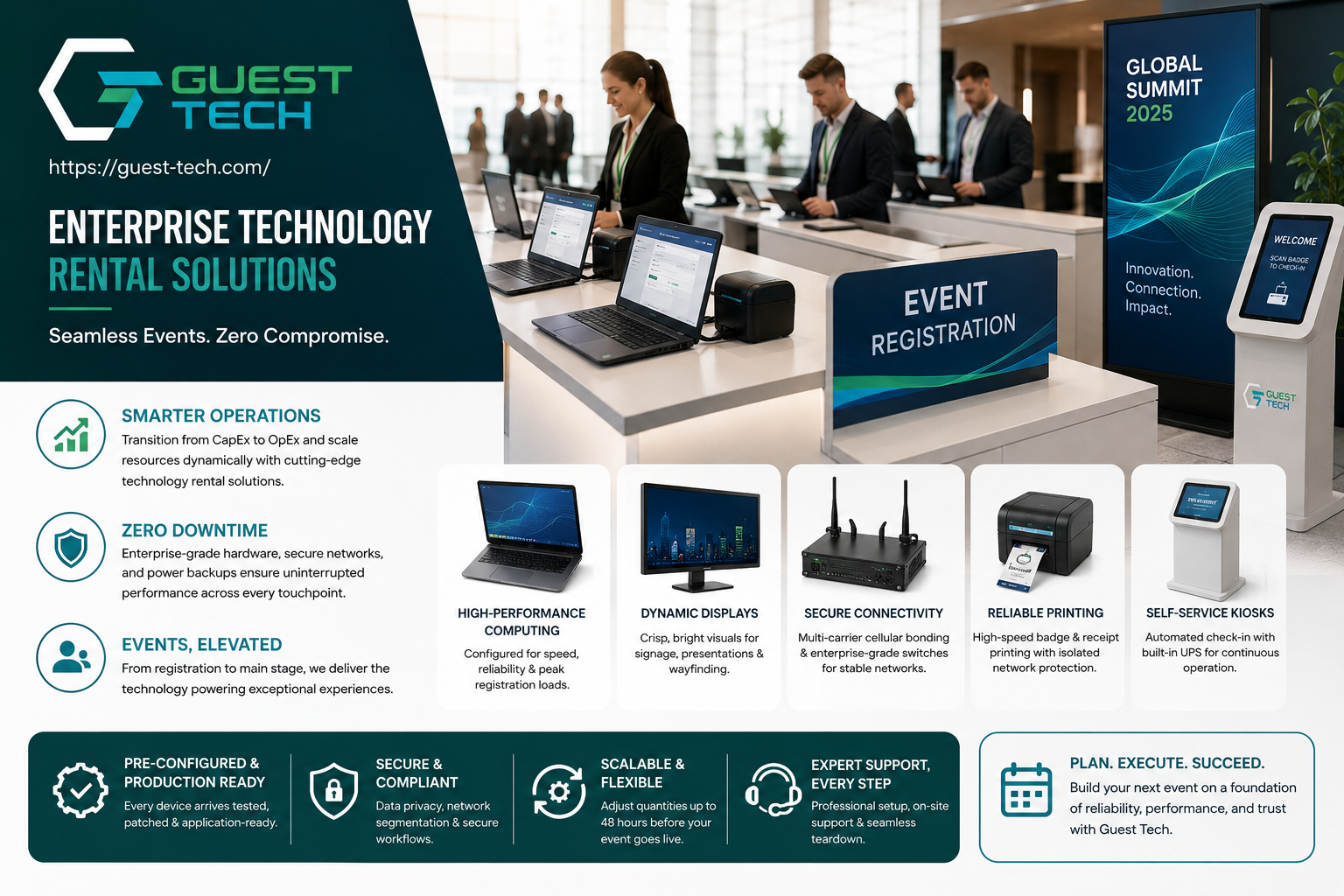
Securing a professional technology rental framework guarantees seamless execution for large-scale enterprise corporate events. Managing hardware logistics for a major corporate conference requires meticulous planning and reliable deployment. Selecting an enterprise technology rental partner ensures that your check-in desks, speaker stages, and breakout rooms remain fully operational without capital expenditure bloat. To establish smooth operational workflows, event organizers must audit their technical requirements well in advance. Professional support options simplify setup and teardown logistics.
Transitioning from a capital expenditure (CapEx) hardware purchasing framework to an operational expenditure (OpEx) framework allows enterprise event planners to scale resources dynamically. Rather than managing depreciating hardware assets in a warehouse, corporate logistics teams leverage current-generation enterprise machines configured precisely to localized network specifications. This specialized approach guarantees zero technical debt and ensures hardware consistency across regional or international conference locations.
Why Enterprise Technology Rental Outperforms Procurement
When evaluating an operational logistics strategy, executing a comprehensive technology rental strategy saves valuable technical resource time. Sourcing equipment through a unified vendor contract consolidates delivery lines, unifies technical support, and standardizes user terminal configurations across all active tracking zones. Managing a high-volume event registration workflow demands total coordination between staff and technical networks.
Strategic Asset Allocation Benefits
Up-to-Date Systems: Access the newest processing chips, crisp displays, and high-capacity wireless modems without long-term ownership depreciation.
Pre-Configured Software Stacks: Every rented node arrives with clean operating system builds, security patches, and localized registration application profiles pre-loaded.
Scalable Infrastructure: Easily adjust hardware quantities to match changing attendee registration metrics up to 48 hours before site launch.
Selecting Your Technology Rental Infrastructure Components
An efficient registration environment relies on coordinated hardware components that communicate cleanly. Integrating a modern technology rental configuration simplifies the onboarding pathway for attendees, VIP guests, and exhibitors alike.
High-Performance Computing Stations for Event Registration Panels
Registration desks serve as the primary physical touchpoint for attendees. Staff members need fast, responsive machines to manage registrations, print credentials, and process walk-in payments. Securing a premium laptop rental fleet prevents system lagging during morning registration bottlenecks. Deploying an optimized hardware fleet via an enterprise technology rental contract guarantees that processing terminals possess the required memory and speed parameters.
For heavy database applications, API calls, and simultaneous ticket-printing scripts, registration computers require specialized configuration profiles:
Memory Overhead: Minimum 16GB RAM to support continuous browser-based cloud scanning without data buffer page-freezes.
Processing Units: Core i7 or equivalent multi-core architectures optimized for background asynchronous multi-threaded data fetching.
Local Cache Storage: High-speed Solid State Drives (SSDs) configured to store offline attendance logs in the event of localized gateway dropouts.
Furthermore, general session rooms and exhibition halls require bright visual displays for dynamic schedules, speaker presentations, and interactive floor plans. High-resolution presentation displays keep attendees engaged and informed throughout the venue space.
Display Layout Classifications
Depending on spatial layouts, visualization panels are split into distinct tiers:
| Display Deployment Category | Primary Application Environment | Technical Specification Standard |
| Registration Desk Signage | Overhead Check-In Lanes | 32-43 inch Commercial Panels, 400 nits Brightness |
| Breakout Room Interactives | Room Entry Doors / Agendas | 15-24 inch Touch Panels, Power-over-Ethernet (PoE) |
| Main Stage Presentation | Plenary Halls / Keynotes | High-Density Seamless Modular LED Walls, 4K Input |
| Exhibitor Booth Displays | Trade Show Floor Stands | 55-65 inch Floor-Mounted Smart Panels, Media Loopers |
Establishing Uninterrupted Field Connectivity and Power Backups
Large exhibition halls often experience cellular dead zones due to heavy concrete and steel structures. Providing high-speed internet access across multiple registration kiosks requires robust networking hardware. Organizers who rent printer setups and data terminals must ensure local networks remain stable. A comprehensive technology rental deployment includes cellular router hardware configured with multi-carrier cellular bonding capabilities to maintain consistent pipeline data flows. To further enhance data protection and asset visibility, deploying a secure rfid Badge framework enables real-time verification at every single entry corridor.
Establishing a robust local area network (LAN) topology involves deploying enterprise-grade security switches and localized print servers. By isolating printing communications to an independent physical network tier, data pipelines are completely shielded from public traffic congestion. This network strategy ensures that even if external internet bandwidth degrades during heavy peak registration hours, on-site personnel can continue to execute verification routines and output credentials without interruption.
To maintain uptime across mobile scanning hardware and digital signage panels, planners must deploy localized power systems. Incorporating an automated self service kiosk infrastructure into your technology rental roadmap provides an intuitive interface for both visitors and event workers, allowing them to verify credentials without staff assistance. These self-contained units integrate high-capacity Uninterruptible Power Supply (UPS) modules to smooth out voltage spikes and protect transactional records during sudden facility power shifts.
Compliance, Quality Benchmarks, and Production Standards in Technology Rental
According to official event technology deployment guidelines by the Event Industry Council, reliable local networking prevents data synchronization failures with cloud databases during peak tracking hours. To secure smooth badge production at the gate, arranging a professional event printer rental program ensures zero operational downtime. Maximizing operational returns through strategic agreements reduces configuration failure rates to zero.
Tactical Hardware Checklists for Venue Execution
Pre-Launch Configuration Protocol
Flash all network routing points to the newest secure microcode firmware architectures.
Verify localized dynamic IP address pools can accept 200% of expected hardware assets.
Execute stressful print runs matching peak morning arrivals on all rented hardware units.
Active Launch Operation Checklist
Enforce dedicated power pathways across all barcode capturing and badge delivery arrays.
Isolate registration data channels to ensure administrative activities remain completely secure.
Perform real-time database synchronization sweeps every ten minutes across external lines.
Post-Launch Teardown Metrics
Purge all localized transactional data files from laptop hard drives to guarantee privacy compliance.
Audit raw event analytics to determine hardware performance capacities across high-volume time windows.
Package up all hardware arrays using professional protective cases to eliminate logistical wear.
Enforcing these precise engineering benchmarks guarantees a streamlined environment that protects data integrity, cuts down lines, and establishes a modern foundation for high-end corporate events. By trusting your infrastructure to specialized corporate asset frameworks, management can focus on maximizing attendee engagement and event revenue targets.