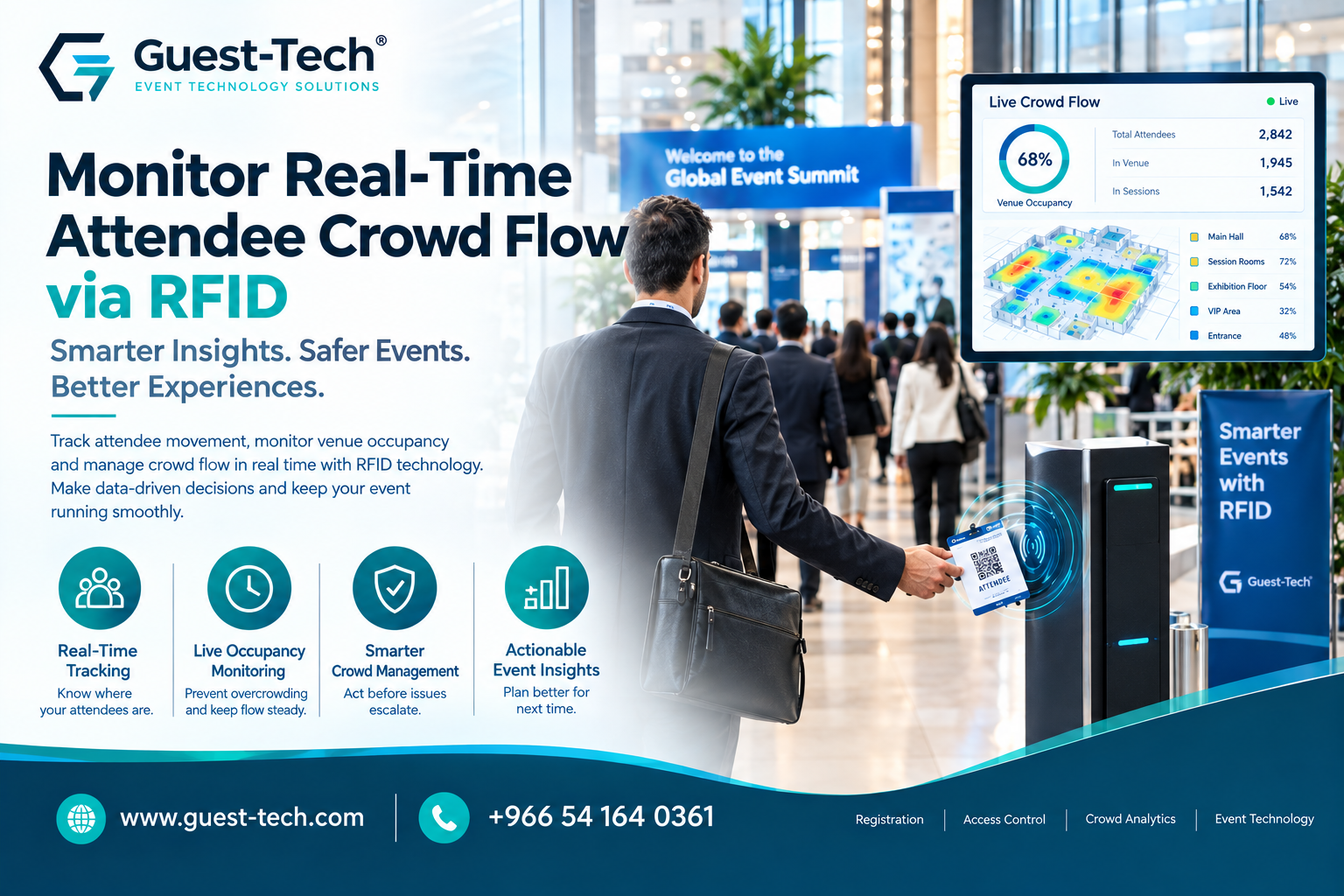
Here's the problem with most crowd congestion at events: by the time someone notices it, it's already happened. An organizer walks past a jammed hallway, or a stream of complaints hits the help desk about a packed session room, and by then there's nothing to do but apologize. Without live visibility into where people actually are, that's the only mode organizers get to operate in: reactive. RFID changes that. Badges with embedded chips get picked up by readers scattered around the venue, at doors, inside halls, near booths, and every pass gets logged automatically. No one taps a scanner, no one stops walking. The data just accumulates in the background while the event runs.
What Is RFID Crowd Flow Monitoring?
RFID (Radio Frequency Identification) isn't new technology; it's the same chip-and-reader principle used in building access cards and retail inventory tags, applied to event badges instead. Each badge carries a chip tied to an attendee's profile. Readers detect it the moment someone walks within range, typically a few feet, and the system timestamps the event without any manual input.
From that raw stream of badge pings, a few things fall out naturally:
- When people enter and leave
- How full a hall is right now, not an hour ago
- Which sessions people are actually sitting in versus the RSVP list
- Which booths are pulling foot traffic and which are being walked past
- Where crowds tend to pool
- When the day's real traffic spikes hit, which is rarely when the schedule says they should
The whole point is speed. A hall creeping toward capacity is something a team can act on while it's happening: open a second entrance, redirect signage, add staff, instead of reading about it in next week's debrief.
How RFID Tracks Attendee Movement
It starts the moment someone picks up their badge at registration. After that, it's mostly invisible: readers positioned around the venue catch badge activity and push it to a central system, which updates a live dashboard organizers can actually watch during the event, not just review afterward.
Pairing this with event registration and visitor management services keeps the tracking data tied to attendee profiles from the moment they check in, rather than treating registration and movement tracking as two separate systems that don't talk to each other.
Benefits of Real-Time Crowd Flow Monitoring
The operational upside is fairly concrete once you're actually watching the data instead of guessing:
- Crowding gets caught and handled before it turns into a complaint
- Staff get redeployed to where the traffic actually is, not where the floor plan assumed it would be
- Attendees spend less time stuck in bottlenecks and more time at sessions or booths
- Venue layouts for next year get built on what people actually did, not what the seating chart predicted
- Post-event reporting has real numbers behind it instead of estimates from staff who "felt like it was busy"
The bigger shift is timing: these are decisions made mid-event, while there's still something to be done about it.
Common RFID Monitoring Locations
Reader placement usually follows wherever crowding risk or reporting value is highest:
- Entrances, where the first bottleneck of the day usually forms
- Exhibition halls
- Session rooms, especially ones prone to overbooking
- VIP areas that need tighter access control
- Registration zones
- Sponsor activations, where traffic data doubles as ROI proof for sponsors
- Any restricted-access point worth auditing
Placement isn't one-size-fits-all. A booth-traffic use case wants denser coverage in the exhibition hall, while a session-attendance use case cares more about doorways into meeting rooms.
Using RFID Data to Improve Event Operations
During the event, this data is mostly about catching problems early: an overcrowded area, a session running past its room's capacity, a booth line that's driving people away instead of drawing them in.
Teams that also run self-service event registration kiosks tend to combine the two, faster check-in on the front end, better visibility once people are actually inside.
But the data doesn't expire when the event ends. It becomes the thing next year's planning is actually based on: which sessions genuinely pulled a crowd (versus which ones just looked good on paper), which zones sat empty all day, and where people naturally clustered regardless of what the floor plan intended.
Planning for RFID Deployment
Most deployment problems trace back to the same handful of decisions made too late: which badge format to use, where readers actually go, how the venue layout affects reader range, and what reports the team will actually need to pull afterward. Sorting these out before the event, not during setup, is what separates a deployment that works from one that leaves gaps in the data.
Guest-Tech's event technology solutions bundle registration, access control, analytics, and attendee management together, so organizations don't end up stitching together separate tools that don't share data.
Frequently Asked Questions
What is RFID attendee tracking?
Badges, cards, or wristbands with an embedded RFID chip that readers detect automatically as people move through a venue. No scanning required on the attendee's end.
How does RFID help monitor crowd flow?
Readers pick up badge activity at fixed points around the venue, so organizers see occupancy and movement live instead of reconstructing it after the fact from staff reports.
What information can RFID tracking provide?
Location, timestamps, hall occupancy, session attendance, booth visits, and movement patterns, essentially a live map of where everyone is and where they've been.
Is RFID suitable for exhibitions and conferences?
Yes, and it's already the default at most large trade shows and conferences for exactly this reason: manual headcounts don't scale past a few hundred people.
Where should RFID readers be placed?
Wherever congestion risk or reporting value is highest: entrances, session rooms, exhibition halls, VIP areas, though the right mix depends on what the organizer actually wants to measure.
Can RFID data improve future events?
Yes. Movement data from past events is usually a better guide to venue layout, staffing, and session scheduling than the assumptions the original floor plan was built on.
See Your Crowd Flow Live, Not After the Fact
Pair RFID crowd tracking with Guest-Tech's registration, access control, and attendee management tools to catch congestion before it becomes a complaint.
Request a Quote