Modern large-scale events demand absolute operational precision. Enterprise events, summits, government conventions, and international exhibitions cannot afford long check-in queues, manual security workflows, or disconnected tracking systems. Implementing a dedicated Event Registration platform optimizes attendee processing, protects data infrastructure, and turns registration data into real-time intelligence.
Optimizing your foundational Event Registration framework eliminates entry bottlenecks and protects event networks. To review the comprehensive framework of these software and hardware modules, analyze the complete suite of visitor management solutions optimized for modern facility networks.
Transforming the Event Registration Lifecycle for Enterprise Scale
Enterprise gatherings have outgrown traditional ticketing tools. Organizers managing summits, trade shows, and high-security government assemblies need specialized infrastructure built for scale, speed, and defense. A modern Event Registration platform serves as the core operating system for an event, controlling attendee data flows from the initial online registration form down to the physical print trigger at an on-site kiosk.
Legacy Event Registration methods create immediate structural bottlenecks. When thousands of global executives, delegates, and vendors arrive simultaneously, reliance on manual alphabetized badge lists or unoptimized software causes long lines and security vulnerabilities. A single point of failure in data handling can delay event kickoffs, damage brand reputation, and introduce major compliance risks.
Modern setups solve these issues by linking digital user profiles with physical access hardware. Using cloud databases and edge processing, these platforms execute Event Registration functions instantly. This unified technical framework shortens the attendee onboarding pathway, reduces front-gate friction, and maximizes lead-generation velocity across your entire exhibition floor space. Sourcing your gate hardware through an integrated event printer rental program ensures zero operational downtime during peak morning hours.
AI-Driven Event Registration Trends Shaping Modern Conferences
Artificial intelligence has shifted from a novelty to a critical operational tool for managing data entry, validating identities, and streamlining the Event Registration architecture at scale.
1. Smart Data Field Filling and Document Extraction
Manual data entry remains a primary source of data duplication and user friction. A modern enterprise Event Registration pipeline uses optical character recognition (OCR) and large language model (LLM) parsers to read business cards, passport details, or government IDs. When a trade show attendee uploads a business card, the system extracts the name, company, job title, and country, automatically populating the form fields in seconds. This reduces form abandonment rates and eliminates human data entry errors.
2. Intelligent Category Matching
For large B2B exhibitions, separating attendees into clear demographic groups is essential for effective marketing and matchmaking. AI algorithms analyze attendee data during the active Event Registration process to categorize profiles automatically. If an individual registers as an “Investment Director specializing in Logistics Infrastructure,” the platform tags them into corresponding investor and industrial tracking categories, removing the need for manual staff database cleanups.
3. Smart Profile Photo Verification
High-security government events require verified profile photos for attendee badges. Manual verification of thousands of uploaded files takes days of labor. Integrated AI tools evaluate image uploads against clear compliance rules within the central Event Registration database:
Identifying improper backgrounds or obstructed faces.
Ensuring the image meets correct resolution requirements.
Flagging mismatching names or suspicious uploads for immediate human review.
This automated validation ensures on-site badge printing runs smoothly without photo formatting issues at the gate.
Optimizing the On-Site Event Registration Experience
The physical entry point is the ultimate test of any technical deployment. On-site check-in solutions must operate reliably, even when local internet networks fail, ensuring that your Event Registration tracking remains continuous and unbroken.
Fast Printing Solutions
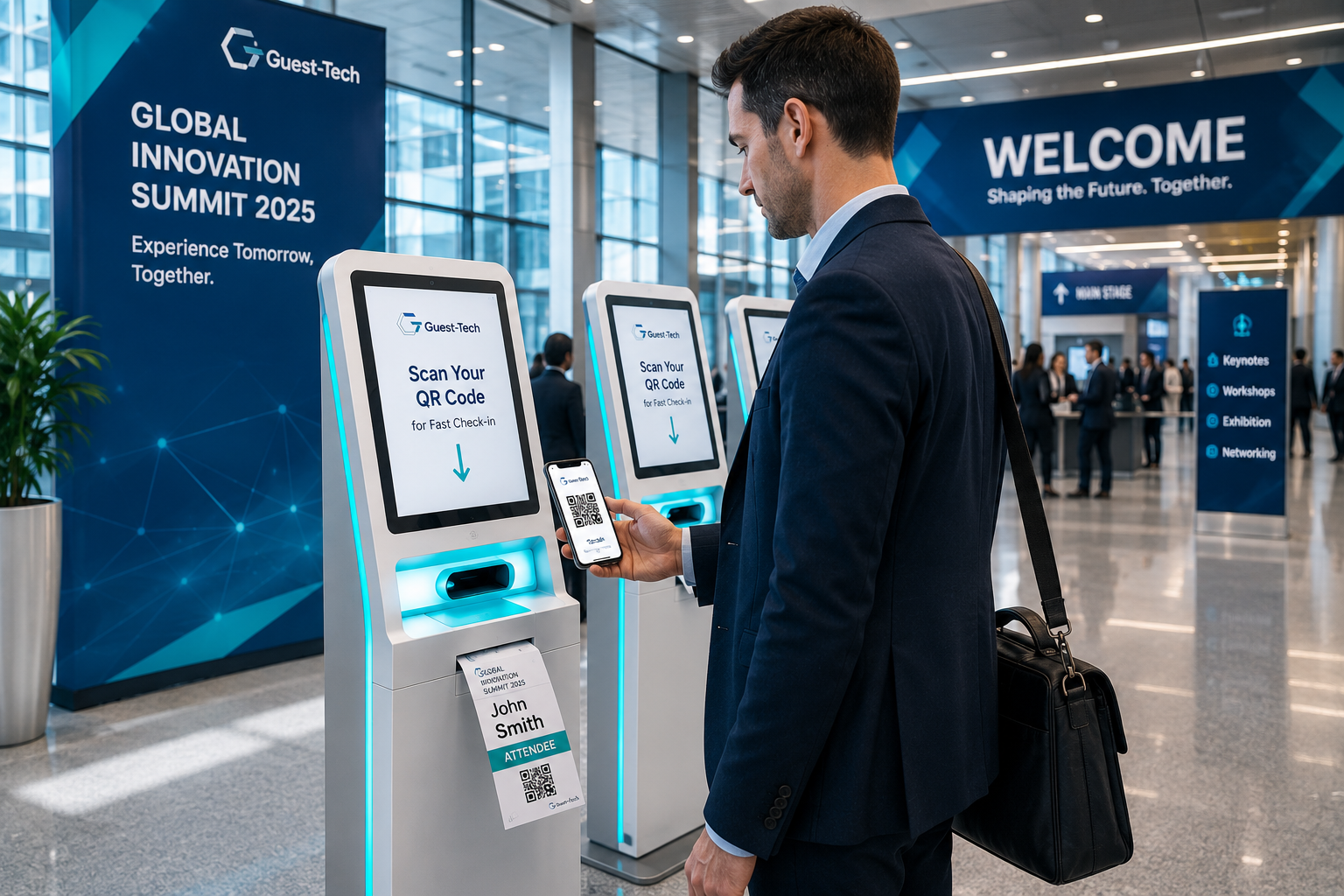
Enterprise systems use high-speed thermal printers integrated into rugged self-service kiosks. Integrating an optimized zebra printer fleet into your entrance setup provides industrial reliability, low mechanical jam rates, and fast script execution. When an attendee arrives, they scan a personalized QR code generated during their initial online Event Registration workflow. The system reads the code, fetches the record from the local edge server, and outputs a double-sided, plastic-coated or heavy stock badge in under two seconds. Minimizing print times prevents crowd bottlenecks at major venue entrances.
Multi-Modal Check-In Systems
Modern entryways offer versatile check-in options tailored to different attendee preferences to accelerate Event Registration processing speeds:
Contactless QR Scanning: High-resolution optical scanners read codes instantly from mobile screens, even with low display brightness.
Facial Recognition (Opt-In): For high-tier corporate VIPs or secure summits, opt-in facial scanning provides hands-free check-in, verifying the user and printing their badge as they walk up to the terminal.
RFID and NFC Access: For multi-day conferences, deploying an rfid Badge framework allows system engineers to monitor spatial density, verify session access permissions, and track attendance automatically across breakout rooms.
Enterprise Event Registration Security and Compliance Blueprints
Managing access rights for international exhibitions and government summits requires robust multi-tier security workflows. According to leading industry studies by organizations like UFI, The Global Association of the Exhibition Industry, event organizers are prioritizing data security and infrastructure speed. A secure Event Registration engine must separate standard attendees from temporary construction crews, vendors, VIP delegates, and security staff.
1. Granular Access Control Lists (ACL)
An enterprise system maps custom permissions to specific badge profiles directly inside the Event Registration dashboard. A vendor profile might allow access to the main floor only during move-in and move-out hours, while a VIP delegate profile opens access to green rooms, executive lounges, and main presentation stages. These permissions are verified instantly at every physical security checkpoint.
2. Multi-Government Background Screenings
For state-level summits, your chosen Event Registration platform must integrate with external security APIs or government clearance systems. Dedicated accreditation modules handle complex structural screening criteria natively to approve or deny applications based on real-time threat-assessment profiles.
3. Dynamic Printing Protections
To stop badge copying and unauthorized transfers, enterprise Event Registration layouts use specialized physical and digital protections:
Holographic Overlays: On-site thermal printers apply custom foil laminates that cannot be duplicated with standard office equipment.
UV Light Inks: High-security badges feature patterns visible only under ultraviolet light inspection.
Encrypted QR Codes: Tokens inside entry barcodes change every 30 seconds via mobile apps, preventing fraud via static screenshots.
Platform Feature Matrix: Enterprise vs. Legacy Systems
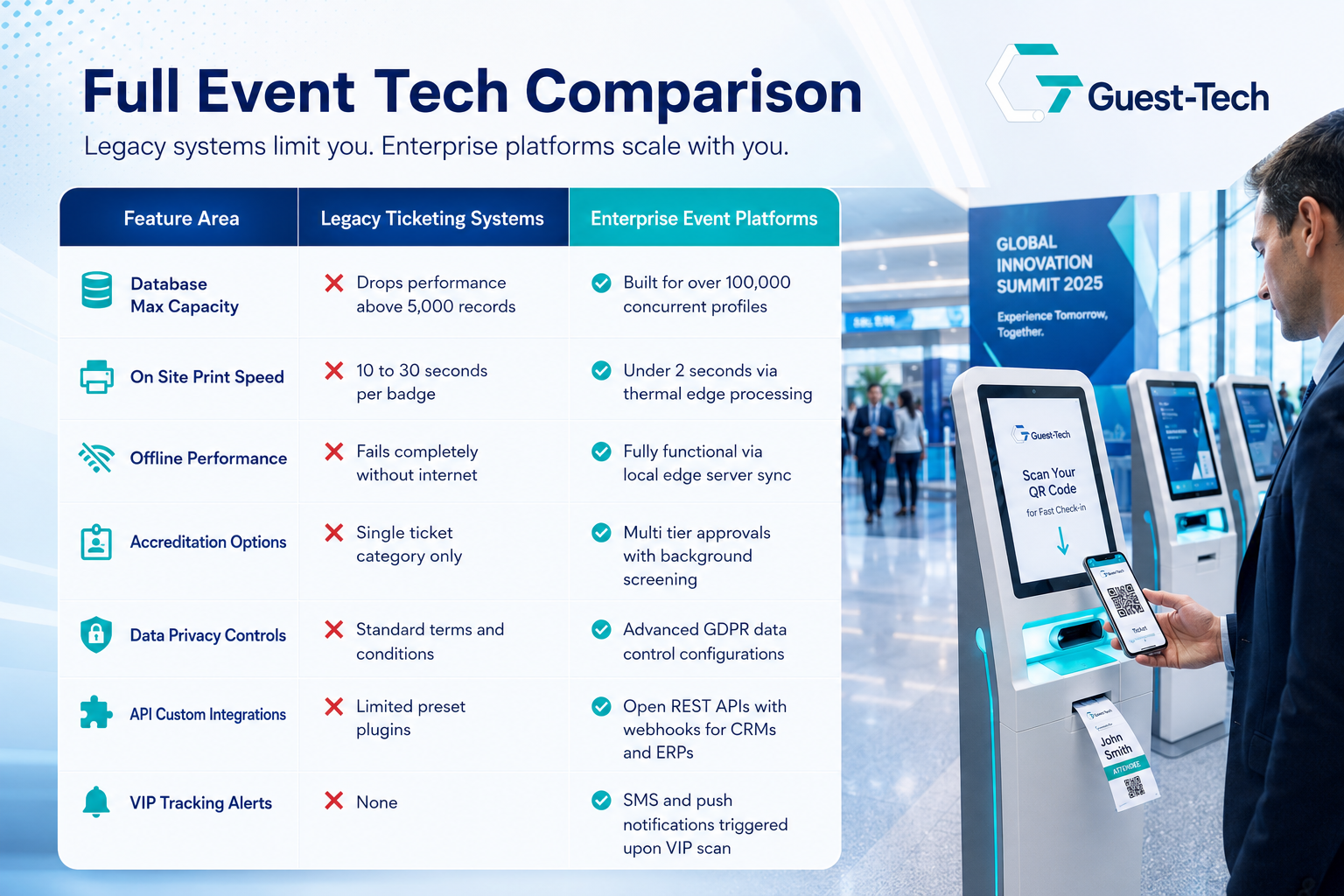
Choosing the right Event Registration technology requires evaluating core system capabilities against project requirements. The matrix below contrasts legacy and enterprise platform architectures.
| Operational Performance Vector | Legacy Registration Platforms | Enterprise Event Registration Systems |
| Data Processing Latency | High; introduces lane lag during peak times | Sub-second response via edge computing nodes |
| Offline Synchronization | Missing; network drops halt entry gates | Full localized caching with automated cloud sync |
| CRM Infrastructure Sync | Manual CSV batch exports required | Real-time REST API and automated webhooks |
| Lead Retrieval Security | Basic unencrypted barcode scanning | Cryptographically signed token scanning arrays |
Production Standards to Safeguard Registration Revenue
According to event execution logistics standards published by the Professional Convention Management Association, keeping check-in processing times down to under four seconds significantly optimizes venue safety and attendee satisfaction. Partnering with professional infrastructure specialists guarantees that technical engineers manage the setup, local network optimization, and data synchronization workflows of your hardware deployment.
To support continuous web-based application scanning without interface freezing, deploying a professional laptop rental infrastructure ensures registration computing nodes meet high hardware baselines, including a minimum of 16GB RAM and multi-core processing profiles.
Tactical Deployment Blueprint for Maximum Onsite Conversions
Pre-Launch Configuration Protocol
Flash all network routing points to the newest secure microcode firmware architectures to prevent script latency.
Verify localized dynamic IP address pools can accept 200% of expected hardware assets simultaneously.
Execute print stress-test runs matching peak arrival metrics to verify perfect text alignment across all machines.
Active Launch Operation Checklist
Enforce dedicated power pathways across all barcode capturing and badge delivery arrays to avoid electrical trips.
Isolate registration data channels to ensure administrative activities remain completely secure.
Perform real-time database synchronization sweeps every ten minutes across external lines.
Post-Launch Teardown Metrics
Purge all localized transactional data files from laptop hard drives to guarantee privacy compliance.
Audit raw event analytics to determine hardware performance capacities across high-volume time windows.
Contact our technical team through our contact page to discuss your structural configuration targets, or take the first step toward a friction-free entryway right now by booking a demo to review our edge printing capabilities, security accreditation workflows, and core integration options.
Enforcing these precise technical standards protects your data pipeline, cuts down line wait times, and builds a professional foundation for your corporate event. By anchoring your entrance infrastructure with a high-performance Event Registration platform, you protect data security, increase lead-generation speed, and unlock massive sales growth across your entire exhibition floor.
Practical Examples: Enterprise Event Success
The value of an advanced event registration platform is best seen through real world applications.
Example 1: Global Energy Summit (High Security)
An international energy summit required strict security clearances for 12,000 delegates, including state ministers and corporate executives. The platform integrated with official background screening databases, blocking badge generation until clearance approvals were confirmed.
On site, opt in facial recognition kiosks processed executive entries in seconds, sending instant SMS alerts to protocol teams the moment a minister cleared the main gate.
Example 2: Massive B2B Industrial Trade Show (High Volume)
A major industrial trade show faced long entry lines, with over 45,000 visitors arriving across three days. By switching from manual registration desks to 25 self service thermal kiosks, the event cut average check in times to under two seconds per person.
Using smart data extraction on the registration form also improved database accuracy, helping exhibitors capture high quality sales leads through integrated scanning apps.
Expert Insights: The Future of Event Technology
According to leading industry studies by organizations like UFI, The Global Association of the Exhibition Industry, event organizers are prioritizing data security and infrastructure speed. Modern event management requires looking beyond basic ticket sales. True operational efficiency comes from unifying data systems, protecting attendee privacy, and automating old manual steps.
As we move through 2026, events will continue to adopt smart identity validation and contact free entry solutions. Choosing a platform that runs on a flexible, API driven architecture ensures event infrastructure can scale effortlessly to meet any future requirement. Learn more about our technical history and deployment expertise on our about us page.
Frequently Asked Questions
What happens to the on site check in kiosks if the venue internet connection goes down?
Enterprise event infrastructure uses a local edge server model. A physical or virtual server on site stores an encrypted copy of the master registration database. Kiosks connect to this server over a local network (LAN), meaning scanning and badge printing keep working perfectly even during an internet outage. The system automatically uploads data back to the cloud once connectivity returns.
How does the platform handle multi tier approvals for high security events?
The platform includes built in accreditation workflows. When an applicant registers under a restricted category (like VIP, contractor, or media), their status is set to “Pending Review.” Event administrators can inspect uploaded documents, run required background checks, and change the profile status to “Approved,” which automatically emails the user their entry pass.
Can the registration system integrate with corporate CRM tools like Salesforce?
Yes. Enterprise platforms feature open REST APIs and webhooks that sync data instantly with tools like Salesforce, HubSpot, Microsoft Dynamics, and SAP. This allows marketing teams to track registration activity, update sales pipelines, and analyze attendee engagement in real time.
What options are available to protect badges from forgery or unauthorized transfers?
Platforms use several security measures, including holographic foil laminates, UV sensitive patterns, and printed headshots. For digital passes, dynamic QR codes refresh every 30 seconds within the event app, stopping users from sharing access via static screenshots.
Does the platform support localized payment options for international events?
Yes. The payment engine integrates with global gateways like Stripe and PayPal, alongside important regional payment options like Mada in Saudi Arabia, Apple Pay, Google Pay, and localized wire transfer tracking.
Key Takeaways
Speed Prevents Bottlenecks: Enterprise thermal printing systems drop physical check in times to under two seconds per person, keeping entry points clear.
Hybrid Systems Secure Connectivity: Local edge server deployments keep on site scanning and printing fully active if the venue’s internet drops.
AI Increases Data Accuracy: Smart automated parsing extracts card and document text accurately, cutting down user friction and form abandonment.
Accreditation Protects Venues: Fine grained access control lists and automated security verification ensure only cleared personnel enter restricted zones.
Data Privacy is Mandatory: Full compliance with GDPR, PCI-DSS, and local data residency laws is essential for protecting modern brand reputation.
Turn Your Event Registration Into a High Efficiency Entry System
Stop letting slow check in queues, disconnected data systems, and security gaps impact your major events. Guest Tech delivers scalable, secure, and fast infrastructure built for worldwide exhibitions, government summits, and enterprise conferences.
Let our engineers show you how to optimize your event infrastructure. Contact our technical team today through our contact page to discuss your structural configuration targets, or take the first step toward a friction free entryway right now by booking a live demo to review our edge printing capabilities, security accreditation workflows, and core integration options.