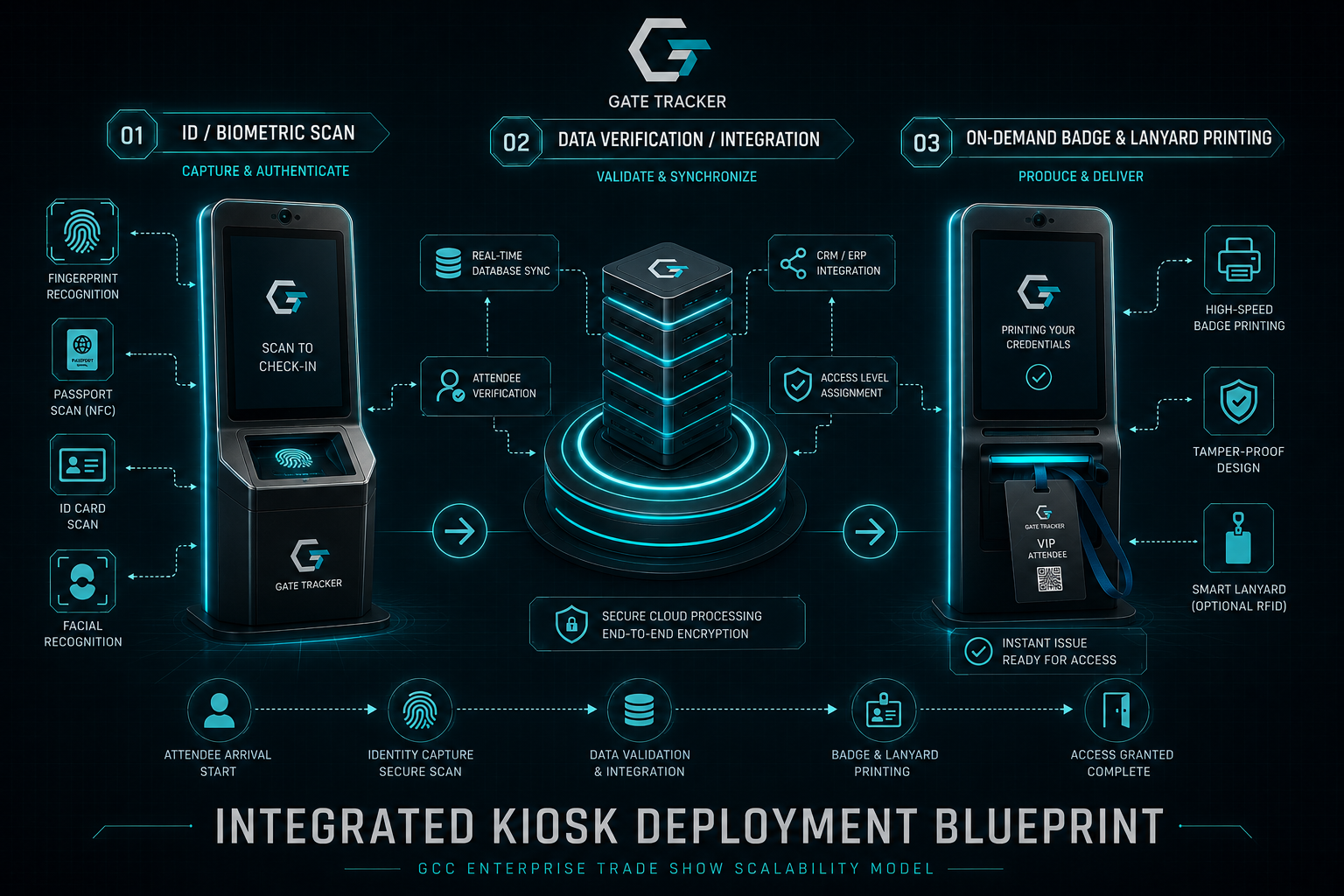
Calculating your total event registration cost is the initial milestone for corporate stakeholders executing high-visibility exhibitions across the GCC region. When procurement departments evaluate technical layouts, predicting accurate hardware allocations ensures that local budgets remain fully optimized without risking operational delays on opening day.
Primary Cost Drivers for Event Registration Systems
Analyzing historical technical metrics shows that structural pricing scales dynamically with real-time operational demands. Anticipating these core factors early in the planning pipeline allows managers to streamline logistics and avoid costly hardware additions.
| Cost Component | Direct Technical Impact |
|---|---|
| Arrival Velocities & Scale | Intense peak-hour check-in spikes necessitate an expanded self service kiosk footprint to avoid entry bottlenecks. |
| Badge Media Architecture | Premium tracking substrates like RFID layers demand higher material budgets than conventional monochromatic direct-thermal stock. |
| Hardware Allocations | Acquiring on-site printing mechanisms, cellular routers, heavy-duty scanners, and local automated power arrays. |
| Support Labor Framework | Deciding between raw gear supply and procuring fully certified system technicians to administer live venue operations. |
| Summit Run Duration | Multi-day trade exhibitions require extended hardware operational cycles, expanding localized support technician timelines. |

Comparing Standalone Platforms and Comprehensive Event Services
When evaluating your technical configuration, choosing the right delivery framework determines long-term platform stability. Transitioning to a dedicated digital registration system enables coordinators to handle pre-show documentation smoothly via automated portals. However, deploying unmanaged systems requires substantial in-house hardware experience to handle local technical faults.
Alternatively, integrating complete, professionally supported event services guarantees that hardware delivery, on-site system integration, regional localized databases, and active backup protocols are entirely managed by dedicated engineers. This premium framework mitigates critical data risks, making it the preferred option for enterprise trade shows across the GCC.
Infrastructure Security and Database Alignment
A vital element in contemporary industrial setups is the secure framework required to process high volumes of sensitive attendee records safely. A modern enterprise event registration engine must utilize advanced end-to-end encrypted data transmission channels alongside standardized local protection methods to fulfill regional cybersecurity mandates.
Deploying active local database mirrors ensures complete processing survivability even during total network blackouts at large venues. Ensuring that your local technical infrastructure vendor actively provisions real-time hardware redundancy prevents long queue wait times and secures system throughput if an external internet service drops unexpectedly.
Proven Tactical Protocols to Optimize Budget Allocations
- Maximize Pre-Show Verifications: Incentivizing attendees to secure credentials early drops live desk requirements, reducing on-site hardware investments.
- Select Balanced Substrates: Standardizing on sustainable materials like a high-density Fanfold badge achieves strict corporate eco-targets while lowering production costs compared to rigid acrylic layers.
- Leverage On-Demand Logistics: Selecting to strategically rent printer assets removes ongoing warehouse upkeep fees, depreciation costs, and complex device firmware updates.
According to professional research guidelines detailed by international organizations like Meeting Professionals International, early configuration mapping remains the most effective technique to control infrastructure expenses while ensuring top-tier execution.
Frequently Asked Questions
What main factors dictate the ultimate cost of event registration? +
Total financial allocations are decided by maximum audience size, peak check-in frequency curves, chosen badge dimensions, on-site networking requirements, engineering labor support, and show length.
Are standard flat-rate pricing menus available for enterprise scale? +
No. Because venue security standards, custom badge layouts, and local data compliance metrics change with each project, premium providers build tailored itemized bids matching the exact event configuration.
Is direct equipment hardware rental more practical than outright purchase? +
Yes, for the vast majority of international event organizers. Choosing temporary logistics loops avoids large capital investments, inventory depreciation, annual diagnostics, and tech obsolescence.
Seeking an Accurate Budget Outline for Your Next Exhibition?
Share your operational metrics, peak traffic windows, and target badge layouts to receive a fully transparent, line-item deployment proposal from our field engineering team.
Request a Tailored Proposal