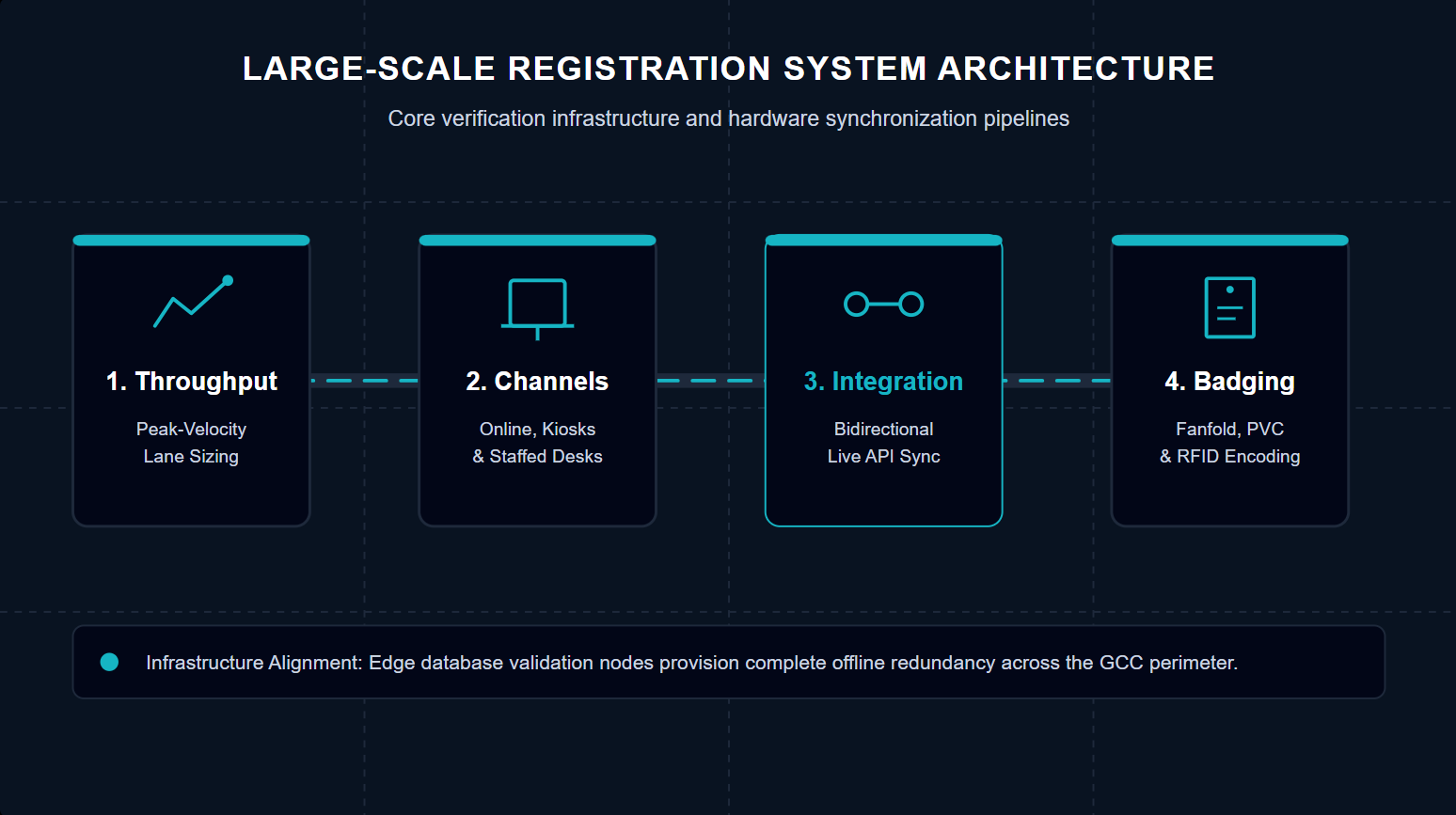
Choosing a professional event registration system is the definitive factor that determines whether your large-scale exhibition experiences a calm entry sequence or an unmanageable queue out the door. For conventions welcoming thousands of simultaneous attendees across the GCC region, engineering a secure, high-capacity check-in infrastructure eliminates operational risk.
1. Start with throughput, not headcount
The overarching metrics defining success for an enterprise-grade deployment do not rest on total registration tallies, but rather on maximum simultaneous arrival velocity. According to official data methodologies shared by Meeting Professionals International, engineering terminal flow requires exact math. Determine your physical layout configurations and hardware lane allocations by running this core operational formula:
attendees ÷ arrival window ÷ seconds-per-check-in = lanes needed
When configuring a high-volume event registration system, mapping your peak rush hours prevents system stall-outs. For instance, if the vast majority of your registered audience arrives within a condensed two-hour morning window, your layout must be designed to withstand that specific concentrated surge. Utilizing automated self-service kiosks alongside traditional staffed support desks expands your overall lane capacity, while incentivizing digital pre-registration effectively shortens the active transaction processing time required per attendee down to mere seconds.
2. Use every registration channel simultaneously
Relying on a single entry mechanism introduces extreme operational risk. A resilient event registration system architecture relies on multiple redundant channels functioning in parallel to distribute load across your venue footprint.
| Channel | Speed | Best for |
|---|---|---|
| Online pre-registration | Fastest on arrival (scan only) | Clearing peak windows |
| Self-service kiosk | Under a minute, in parallel | Reducing staffing and queues |
| Staffed desk | Flexible, handles exceptions | Walk-ins and complex cases |
Integrating a high-performance self service kiosk deployment allows hundreds of guests to complete verification simultaneously. The most secure event frameworks perfectly execute all three processing layers concurrently to fully protect your main entrance corridors from sudden congestion bottlenecks.
3. Tie your event registration system to badging hardware
Data verification and physical print commands should always be combined into a single continuous workflow. The instant your event registration system confirms a guest's identity credentials, a real-time command must automatically generate their credential. Evaluating your full operational budget, including specialized event registration costs, helps establish robust technical frameworks early without unexpected project creep.
Decide during the initial technical strategy phase whether your audience requires ultra-durable PVC options, layered fanfold paper, or rapid thermal badges. Furthermore, determine if specific high-security zones require embedded RFID tracking chips to support automated regional access control and advanced movement auditing across restricted presentation rooms.
4. Demand native real-time integration
A professional software platform must support uncompromised, bidirectional data synchronizations. Your operational event registration system must continuously feed data back and forth between your central database and active on-site hardware arrays. This synchronized data layer provides a single source of truth for online sign-ups, VIP check-ins, and floor metrics. Relying on manual data exports between fragmented systems introduces critical human error, leading to slower check-in times and disruptive duplicate credentials.
5. Insist on live operational visibility
A modern, enterprise-grade event registration system must deliver immediate dashboard analytics to organizers during active event hours. Having access to live attendee scans and regional zone headcounts allows managers to rapidly reallocate staffing resources straight to lines where queues are building up. Following the closing ceremonies, this comprehensive dataset transitions into a verified analytical report for stakeholders, establishing perfect visibility into exact conversion metrics and programmatic ROI values.
6. Infrastructure, connectivity, and the on-site engineering team
The primary software dashboard constitutes only half of a functional on-site ecosystem. Organizers must look closely at who provisions and supports physical equipment assets, including industrial high-speed printers, optical barcode scanners, check-in kiosks, independent 5G network routers, and backup power delivery systems. Procuring specialized services that bundle both hardware deployment and ongoing management ensures absolute infrastructure safety on the floor.
To protect your event from venue power grid instabilities, deploying enterprise-grade technical equipment with fully redundant local networks is mandatory. GUESTECH delivers the complete technical stack backed by an active, on-site engineering squad, ensuring that an isolated hardware failure or local network drop will never stop your check-in lines from advancing smoothly.
Frequently Asked Questions
What should a large-event registration system include?
At minimum: online pre-registration, fast on-site check-in by QR or RFID, on-demand badge printing, two-way integration with your event platform, live attendee reporting, and an on-site team with backup hardware.
How many check-in lanes do I need?
Divide your expected attendees by the arrival window and your per-person check-in time. For example, 10,000 arrivals over two hours at 30 seconds each needs roughly 42 simultaneous lanes across kiosks and desks. We size this for you.
Should attendees pre-register or register on arrival?
Both. Pre-registration clears the busiest windows because those guests only need a quick scan, while staffed desks and kiosks handle walk-ins on the spot.
Does the system integrate with our existing event platform?
Yes. A good system syncs both ways with your event management platform so registration and check-in data flow without manual exports or duplicate lists.
Do we need our own internet?
It helps to have a backup. GUESTECH brings fixed and mobile 5G routers and portable power so check-in keeps running independently of venue Wi-Fi.
Planning a large event in Riyadh or the GCC?
Tell us your dates and expected numbers, and we'll come back with a registration plan and quote.
Get a registration plan